How to Become a Wildland Fireline EMT (FEMT)
Learn how to become a Wildland Fireline EMT (FEMT). Get Red Card certified, pass the arduous pack test, and build a 14-day line bag packing list.
· 6 min read
Read →
Compare common EMS shift rotations. Learn how 24/48, 48/96, 12-hour Pitman schedules, and Kelly Days work, with tips on surviving 24-hour shifts.
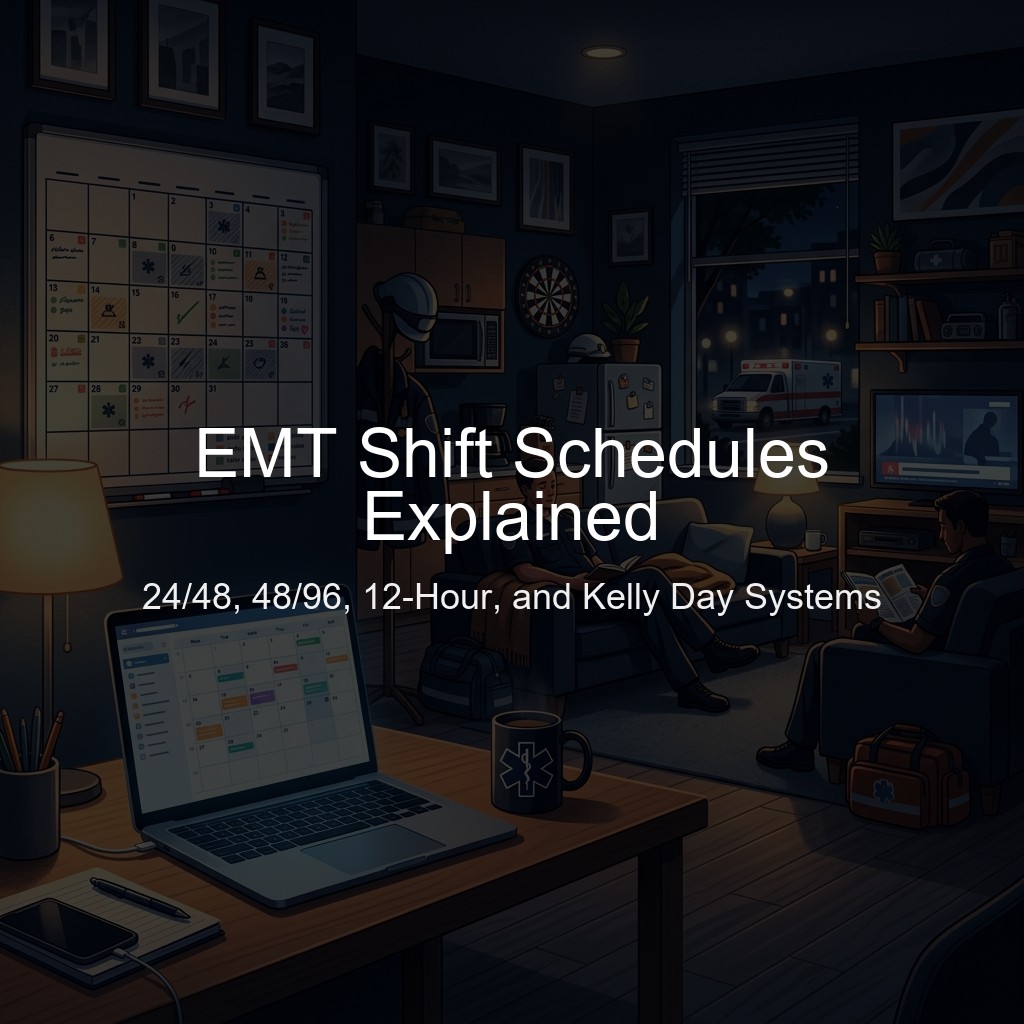
Working in Emergency Medical Services (EMS) is not a standard nine-to-five job. Because emergencies happen around the clock, ambulance crews and fire departments must maintain constant coverage. This requires unique, rotating shift patterns that can seem confusing to newcomers.
Whether you are preparing for your first EMT job or simply exploring career pathways in prehospital care, understanding how these schedules operate is critical. Shift systems dictate not only when you work, but how you sleep, how you recover, and how you manage your personal life.
This guide breaks down the most common EMS shift rotations, explains key terms like “Kelly Days,” and offers practical strategies for surviving long hours in the field.
EMS agencies deploy several different schedule designs to balance crew coverage with labor costs. Here are the three most common systems.
The 24/48 rotation is the traditional schedule pattern for municipal fire departments and fire-based EMS systems.
The 48/96 schedule has surged in popularity across western fire departments and rural EMS agencies because it reduces commute times and provides longer blocks of time off.
Many private, high-volume transport agencies prefer 12-hour shifts to prevent crew fatigue and keep ambulances constantly staffed. The most popular 12-hour pattern is the Pitman schedule (also known as the “2-2-3” schedule).
Because a standard 24/48 schedule averages 56 hours per week, it exceeds the standard 40-hour work week. Over a year, this results in significant overtime costs for municipalities. To balance this, agencies introduce the Kelly Day.
Named after the fire chief who introduced the concept, a Kelly Day is a regularly scheduled shift off duty that occurs once every few cycles.
Choosing the right agency often comes down to deciding between 12-hour and 24-hour shifts. Consider these trade-offs:
Stepping onto your first 24-hour shift can be intimidating. Follow these basic survival tips to keep your performance high and your stress levels low:
Test your understanding of rotations and shift designs.
You are hired on a 48/96 shift rotation. Which of the following describes your regular work schedule under this system?
Filed Under
About the Author
I'm a veteran EMT with 13+ years of field experience in EMS. I started EMT Training Station to help aspiring EMS professionals get the information they need — from training and certification to gear and career advancement. I've worked in Arizona and Michigan and participated in Hurricane Michael FEMA relief.
Learn how to become a Wildland Fireline EMT (FEMT). Get Red Card certified, pass the arduous pack test, and build a 14-day line bag packing list.
Learn how to become a flight paramedic. Read this step-by-step career roadmap covering clinical requirements, critical care certifications, and physical standards.
A veteran responder's guide to writing an EMS resume and passing the oral interview. Includes resume templates, certification checklists, and practice questions.