How to Become a Flight Paramedic: The Complete Career Track
Learn how to become a flight paramedic. Read this step-by-step career roadmap covering clinical requirements, critical care certifications, and physical standards.
· 8 min read
Read →
The best EMT knives and rescue tools reviewed by a working paramedic. Top picks include the Gerber Hinderer, Leatherman Raptor, and more — compared by portability, durability, and field utility.
Last updated: March 2026
A proper EMT knife is much more than a blade with a star of life on it. Rescue tools help a first responder gain quick access or assess a patient during trauma or medical emergencies.
This article covers the best EMT knives and rescue tools on the market — from a battery-operated pulse oximeter to a monster multi-tool with 16 instruments in one. Everything on this list helps with patient care in an emergency setting.
When selecting a rescue tool, think about your job. Are you part of a trauma (911) rescue agency, or mostly part of a private medical transport agency? Your tool should fill one critical role or multiple roles — for example, a pocketknife that also has a seatbelt cutter and a glass breaker. One-handed operation is another key feature to prioritize.
| Product | Best For | Price | ||
|---|---|---|---|---|
| 1 | | Gerber Hinderer Rescue Knife | Best overall EMT knife | Check Price ↗ |
| 2 | | Leatherman Raptor Trauma Shears | Best purpose-built rescue tool | Check Price ↗ |
| 3 | | Madison Supply EMT Belt Tool Kit | Best budget kit | Check Price ↗ |
| 4 | | StatGear T3 Tactical Auto Rescue Tool | Best affordable rescue tool | Check Price ↗ |
| 5 | | Leatherman OHT Multi-Tool | Best multi-tool | Check Price ↗ |
| 6 | | Benchmade Triage Rescue Knife | Best premium knife | Check Price ↗ |
| 7 | | StatGear SuperVizor XT | Best ultra-budget pick | Check Price ↗ |
| 8 | | Smith & Wesson 1st Response | Best EDC knife | Check Price ↗ |
| 9 | | Turnout Tools Titanium Multi-Tool | Best for firefighter/EMS | Check Price ↗ |
| 10 | | Swiss Safe 3-in-1 Tactical Knife | Best gift for EMT students | Check Price ↗ |
There are amazing tools on the market for EMTs, Paramedics, and other emergency responders. Rescue tools need to be easily accessible and quick and simple to use.
Having a personal tool — instead of only using the tools on the ambulance — allows the first responder to quickly access patients with tools that may not be on the rig. For instance, most rigs are not stocked with a glass breaker; the shears are the cheapest on the market and might not retain sharpness long enough to completely trauma strip a patient.
For the exact same reasons you should own a personal stethoscope, it is a good idea to invest in a rescue tool that suits your job role. Does your unit run emergency rescue calls? Probably a good idea to have a Raptor. Do you primarily do medical transports? You can probably get away with a less expensive tool, like the SuperVizor.
When selecting the knives and rescue tools on this list, I based my selections on three factors from personal experience and input from other first responders:
The Gerber Hinderer Rescue Knife is Gerber’s entry into the EMT knife world — and it’s a testament to the brand. Gerber Gear has been designing and engineering products in the US since 1939, outfitting hunters, skilled workers, and soldiers. This knife was designed by knifemaker and firefighter Rick Hinderer as a true rescue tool.
The Hinderer is designed for one-handed operation and includes:
One practical use case: when a patient is trapped in a vehicle, the hook cutter quickly and safely cuts through a seatbelt while the window punch gains access to the patient. The O2 wrench means you can administer life-saving treatment without fumbling for a separate tool.
Pros
Cons
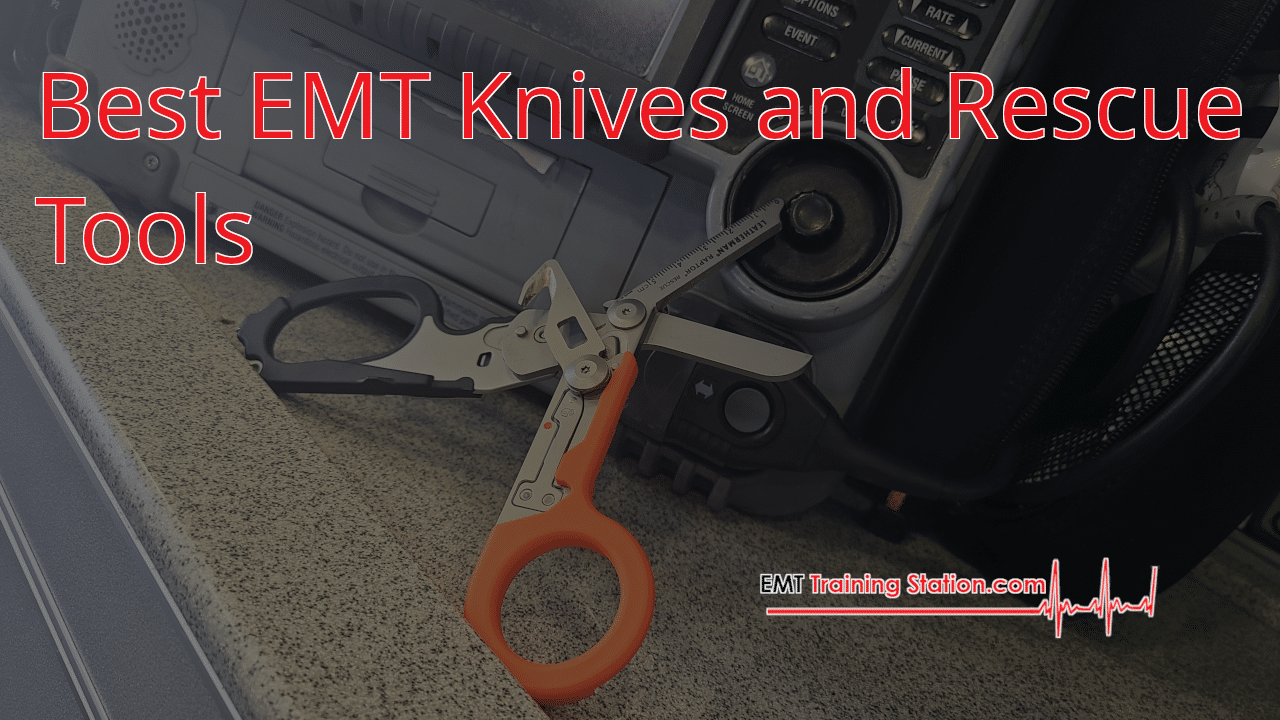
What list of rescue tools would not include the Leatherman Raptor? This is my most-used tool on the job and Leatherman’s mission-specific EMS rescue tool.
The name Leatherman is well-known for quality multitools. The Raptor is made from 420HC stainless steel — the same metal used in surgical scalpels — brought to a higher hardness than standard 420. The blade is very resistant to wear and the shears come with a 25-year manufacturer’s warranty.
With the Raptor you get 6 tools in one compact package:
Read our full Leatherman Raptor review for an in-depth look.
Pros
Cons
Compact and easy to add to any EMS kit. Madison Supply’s EMT Belt Kit includes fluoride-coated trauma shears, bandage scissors, tweezers, forceps, hemostats, and a penlight with a pupil gauge — all in an included woven nylon belt pouch.
These are professional-grade, durable tools perfect for shift use. Madison Supply offers a 60-day unconditional guarantee. Each tool is easy to clean and functions great under trauma conditions.
Pros
Cons
The StatGear T3 is affordable and effective. It features a 440c stainless steel serrated blade for general cutting and a 440c hook cutter for seatbelts and clothing. The spring-loaded window punch makes short work of automotive glass, and a 5-lumen LED emergency light rounds out the kit.
The light is bright enough to illuminate tight spaces but not so bright it can’t be used to check pupil responses. The knife ships with a heavy-duty nylon sheath.
One note: after repeated use of the spring-loaded window punch, the screws may require tightening. The 440c blade cuts very well but needs more frequent sharpening than higher-quality steel.
Pros
Cons
The Leatherman OHT makes this list because every one of its 16 tools can be operated with one hand. OHT stands for One-Handed Tool.
Veteran first responders know that sometimes you have to fix things on the ambulance — screws come loose, nuts need tightening. The OHT is the “it’s better to have it and not need it” tool that covers all of those situations and more. It can be used outside the rescue world as well.
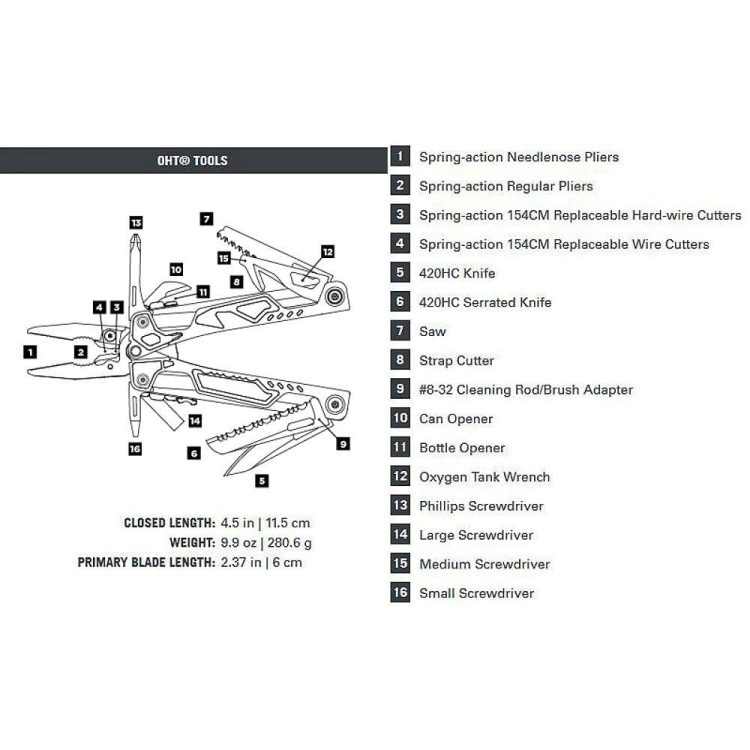
The OHT was nearly the top pick on this list. It only lost to the Raptor because the Raptor is purpose-built for first responders. If it had trauma shears and a ring cutter, the OHT would have taken the top spot.
Pros
Cons
The Benchmade Triage is an exceptional rescue knife. It features a blunted partially serrated blade in corrosion-resistant N680 stainless steel — one of the best blade steels available. The Triage also includes a strap cutter and a window punch, with spring-assisted one-handed opening.
Benchmade knives are built to last. This knife is covered by a lifetime warranty that includes a sharpening service — probably the last knife you will ever need to purchase.
Pros
Cons
Simple and effective. The StatGear SuperVizor XT costs about as much as a fast food meal and gives you a steel glass breaker and a hook strap cutter. It ships with a sheath that attaches directly to any car visor.
Attach it to your ambulance visor at the start of your shift — glass breaker ready to go the moment you pull up to a crash scene. If you forget it at the end of your shift, its low cost makes it easy to replace.
Pros
Cons
The Smith & Wesson 1st Response is a solid everyday carry rescue knife designed specifically for first responders, military personnel, and outdoor enthusiasts.
A seatbelt cutter and glass breaker are built into the handle for fast vehicle extrication. The textured G-10 handle provides a secure grip even in wet or slippery conditions. The partially serrated high-carbon stainless steel blade with black oxide coating adds durability and resistance to wear.
Ambidextrous thumb studs and a liner lock mechanism make one-handed opening easy, and the stainless steel pocket clip keeps it accessible at all times.
Pros
Cons
The Turnout Tools Titanium Multi-Tool is an essential tool for any new firefighter or EMS provider dealing with oxygen and gas systems. Made from a strong titanium alloy, it’s built to withstand high levels of heat and pressure.
The medical oxygen valve tool lets you quickly open or close oxygen tanks. Its simple design means even new EMTs can master it quickly, and its compact size makes it easy to carry in any gear bag.
Pros
Cons
The Swiss Safe 3-in-1 rounds out the list. Built with a 3mm thick high-performance steel blade, a lightweight aluminum handle, and a pocket clip, it’s a compact and convenient tool for emergency responders.
The assisted opening with a flipper tab provides reliable one-handed deployment. The signature EMT-orange colorway makes it easy to locate in a dark bag or on a cluttered rig. The glass breaker, seatbelt cutter, and blade serrations cover the core rescue scenarios.
Pros
Cons
An EMT knife is a specially designed knife primarily used by emergency medical technicians for rescue operations — cutting through seatbelts, clothing, and other materials during emergencies. The best ones also include tools like a glass breaker, O2 wrench, and strap cutter.
A good EMT knife should have: a serrated edge for tough materials, a sturdy non-slip handle, one-handed operation, and ideally multiple integrated tools (strap cutter, glass breaker, O2 wrench). Corrosion-resistant steel and a reliable locking mechanism are essential.
Yes. Most EMT knives and rescue tools double as everyday carry options — great for camping, outdoor work, or general utility. They’re designed to be tough enough for emergency use, which means they handle everyday tasks with ease.
The Gerber Hinderer Rescue Knife is the best overall EMT knife for most responders. It combines a quality blade with a hook cutter, glass breaker, and O2 wrench in a one-handed package with a lifetime warranty.
In most jurisdictions, yes — but laws vary by state and locality. Always check your local regulations on blade length and knife types before carrying any knife on or off the job.
Use a sharpening stone, honing rod, or electric sharpener. Follow the manufacturer’s recommended angle (typically 20–25°). Knives made from 440A/440C steel will need more frequent sharpening than higher-carbon steels like N680.
Keep it clean and dry after each use, especially after contact with bodily fluids. Oil the blade and pivot points regularly. Store it in its sheath in a dry location. For multi-tools like the Raptor, rinse pivot points with water after heavy use and allow to air dry.
Filed Under
About the Author
I'm a veteran EMT with 13+ years of field experience in EMS. I started EMT Training Station to help aspiring EMS professionals get the information they need — from training and certification to gear and career advancement. I've worked in Arizona and Michigan and participated in Hurricane Michael FEMA relief.
Learn how to become a flight paramedic. Read this step-by-step career roadmap covering clinical requirements, critical care certifications, and physical standards.
Compare the best trauma shears for EMTs and paramedics. Read reviews of the Leatherman Raptor, XShear, Fiskars Pro PowerArc, and standard disposable medical shears.
An in-depth review of the Armitron Sport Women's Digital Chronograph. A veteran EMT evaluates its compact resin protection, 100M water resistance, and budget shift value.