
How to Become a Flight Paramedic: The Complete Career Track
Learn how to become a flight paramedic. Read this step-by-step career roadmap covering clinical requirements, critical care certifications, and physical standards.
· 8 min read
Read →
The best stethoscopes for EMTs and paramedics reviewed by a working first responder. Top picks include the Littmann CORE Digital, Cardiology IV, and budget options — compared by comfort, sound quality, and stability.
Updated February 2026
Looking for the best stethoscope for an EMT or Paramedic can be a daunting task. Stethoscopes are one of the most important tools in an EMT or Paramedic’s arsenal — they allow you to listen to the normally inaudible noises the body makes.
They are used to assess the lungs, bowels, and even detect signs of crepitus when dealing with a suspected bone fracture. EMT-Basics use stethoscopes every day to listen to lung sounds and check blood pressure through auscultation.
While many ambulances and ERs have automated blood pressure machines, these can malfunction, and bumps in the road cause false readings. The most accurate way to check blood pressure in the field is an old-school blood pressure cuff with a quality stethoscope.
For a guide on lung sound assessment, see 8 Lung Sounds Every EMT Should Know. For the underlying cardiac anatomy, see our cardiovascular system guide for EMTs.
Paramedics also need a stethoscope for ET tube placement confirmation and epigastric auscultation to ensure the airway — not the stomach — is being ventilated.
| Product | Best For | Price | ||
|---|---|---|---|---|
| 1 | | 3M Littmann CORE Digital | Best overall — digital amplification | Check Price ↗ |
| 2 | | 3M Littmann Cardiology IV | Best analog — professional standard | Check Price ↗ |
| 3 | | MDF Acoustica Lightweight | Best budget pick | Check Price ↗ |
| 4 | | ADC Adscope 615 Platinum | Best CNC-machined value scope | Check Price ↗ |
| 5 | | 3M Littmann Classic III | Best mid-range Littmann | Check Price ↗ |
EMS professionals have different needs than clinicians in a hospital. They work in moving vehicles, noisy environments, and varying weather conditions. My criteria:
The 3M Littmann CORE Digital Stethoscope is the best stethoscope on the market. You can seamlessly switch between analog and digital listening modes.
The 40x digital amplification means you can actually hear abnormal heart tones in the field — something virtually unheard of in pre-hospital settings with analog scopes. The same capability applies to bowel sounds and any other listening-based assessment.
A mobile app lets you record what you hear during patient contact. This is invaluable for critical situations — perform the assessment, listen back when writing your report.
As an EMT basic, you may not need the CORE for blood pressure or basic assessments. But for Paramedics, transport RNs, and hearing-impaired providers, this is a game-changer. For an in-depth analysis of its battery life, sound waveforms, and noise-cancelling performance, see our hands-on 3M Littmann CORE Digital Stethoscope Review.
Pros
Cons
The Littmann Cardiology IV is the go-to stethoscope for healthcare professionals. It has the best analog sound quality on the market — the only reason the CORE edges it out is the digital enhancement.
The dual-lumen tube is encased in a single outer tube — perfect for ambulance use. No exposed lumens to knock together during transport. Heart tones, lung sounds, and bowel sounds are easy to hear while traveling down the road.
The bell rotates to switch between adult and pediatric sides, making this one of the most versatile scopes available. It’s backed by 3M’s 7-year warranty.
If you are a current paramedic or an EMT planning to make EMS a career, the Cardiology IV is the first and last scope you will likely buy. For a full evaluation of its thick acoustic tubing and diaphragm performance, read our complete 3M Littmann Cardiology IV Stethoscope Review.
Pros
Cons
The MDF Acoustica is an outstanding stethoscope for the price. It fits nicely in the ear, includes multiple ear tips for a custom fit, and the single-tube design resists kinking — great for carrying in a side pocket.
Being a single-lumen scope, the Acoustica doesn’t match the sound quality of dual-lumen models like the Littmann. However, for lung sounds and blood pressures it performs well above its price class. MDF backs it with a lifetime warranty.
There is almost no reason an EMT student shouldn’t own one of these. Even experienced providers often keep one as a backup. New to EMS? See our complete new EMT gear roundup for everything else you’ll need on your first day. To see how it performs on manual blood pressures and for details on its lifetime warranty parts program, check out our MDF Acoustica Lightweight Stethoscope Review.
Pros
Cons
ADC is an underrated brand. The Adscope 615 is CNC machined from lightweight zinc alloy, with an oversized bell and Adsoft Plus silicone ear tips that create an excellent acoustic seal.
Like the Littmann, the diaphragm responds to pressure differences — firm pressure for higher frequencies, light pressure for lower. The reinforced 22-inch PVC tubing and stainless steel binaural provide durability and stability.
ADC includes a lifetime warranty with free consumables (diaphragms and ear tips) when registered. The main drawback: the snug fit becomes uncomfortable after prolonged wear. For a detailed look at its zinc alloy acoustics and offset chestpiece comfort, see our hands-on ADC Adscope 615 Platinum Clinician Stethoscope Review.
Pros
Cons
The Littmann Classic III is the scope I personally carry on the road. Superior acoustics, dual adult/pediatric sides, and a dual-lumen tube encased in a single outer casing — everything needed for pre-hospital use.
The Cardiology IV has noticeably clearer sound, but the Classic III is roughly half the price and handles blood pressures and lung sounds with ease. The diaphragm is easy to clean and resistant to skin oils and salts. It carries a 5-year warranty and is available in multiple colors.
If you want Littmann quality without paying for the Cardiology IV, the Classic III is your scope. To see how this scope holds up to daily disinfection and read about its clinical flexibility, check out our detailed 3M Littmann Classic III Stethoscope Review.
Pros
Cons
Every ambulance provides stethoscopes — but they are cheap, shared between every crew, and often difficult to hear through. Investing in your own scope means:
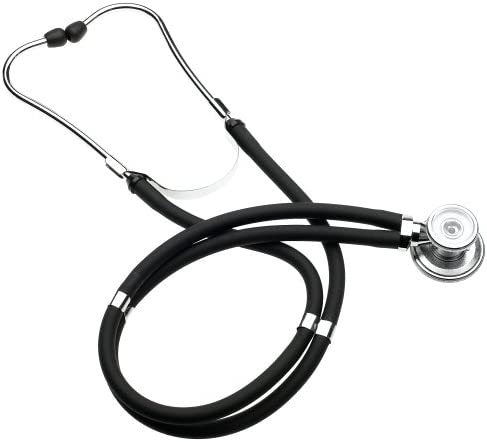
Avoid exposed dual-lumen stethoscopes in pre-hospital settings. The separate tubes knock together during transport, creating noise that drowns out the sounds you’re trying to hear. For less than the price of one of these, you can get the MDF Acoustica with a kink-resistant single tube.
Most experienced EMTs use a Littmann — the Classic III at the entry level, the Cardiology IV for career professionals. New students often start with the MDF Acoustica for its price and reliability.
Yes. In addition to a BP cuff, pens, and trauma shears, you will need a stethoscope to learn blood pressure auscultation and lung sound assessment.
The 3M Littmann CORE Digital — the 40x amplification lets you hear subtleties that analog scopes miss. For an analog option, the Cardiology IV or Classic III are both excellent.
Start with the MDF Acoustica. It handles lung sounds and blood pressures well, won’t break the bank if it gets damaged, and its lifetime warranty means you’re covered. Upgrade to a Littmann when you commit to a career in EMS.
About the Author
I'm a veteran EMT with 13+ years of field experience in EMS. I started EMT Training Station to help aspiring EMS professionals get the information they need — from training and certification to gear and career advancement. I've worked in Arizona and Michigan and participated in Hurricane Michael FEMA relief.
Learn how to become a flight paramedic. Read this step-by-step career roadmap covering clinical requirements, critical care certifications, and physical standards.
Compare the best trauma shears for EMTs and paramedics. Read reviews of the Leatherman Raptor, XShear, Fiskars Pro PowerArc, and standard disposable medical shears.
An in-depth review of the Armitron Sport Women's Digital Chronograph. A veteran EMT evaluates its compact resin protection, 100M water resistance, and budget shift value.